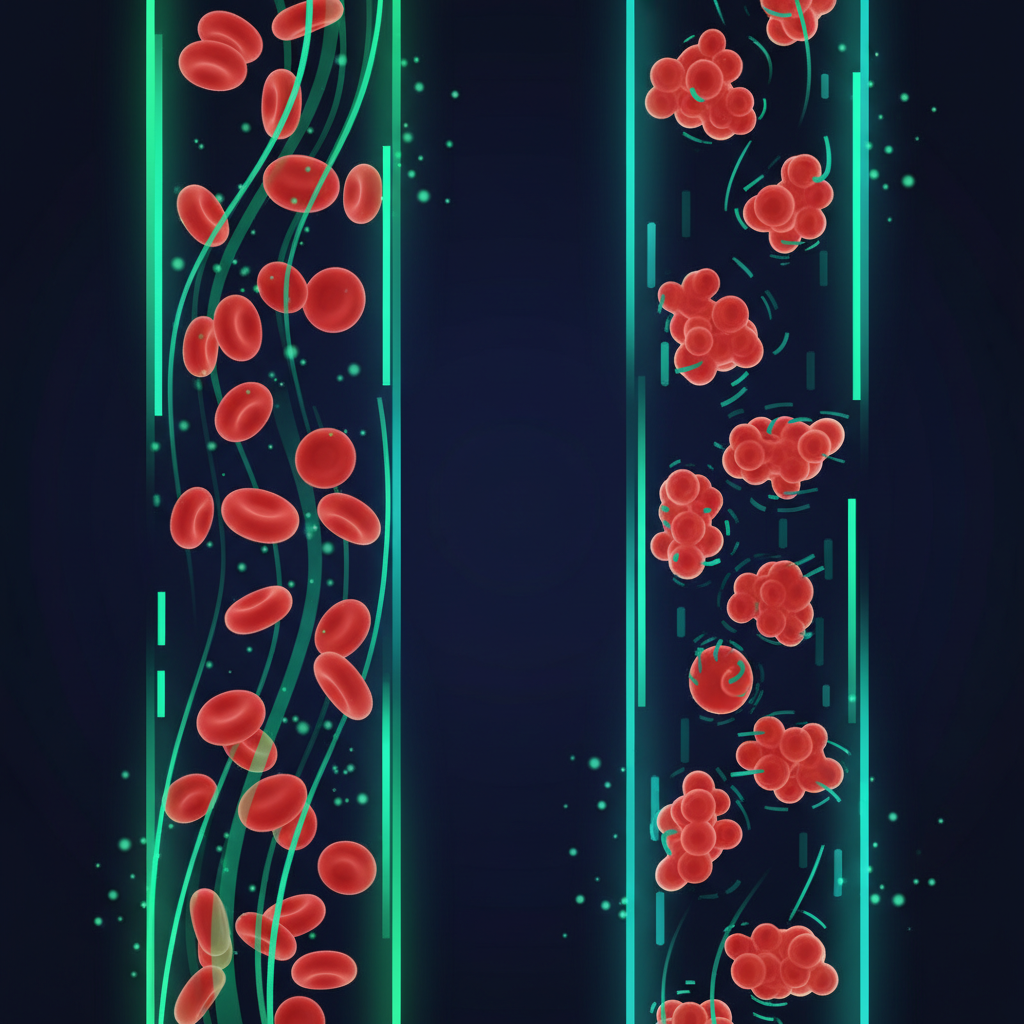
Hematocrit is the percentage of your blood volume made up of red blood cells. Under AAS it rises, sometimes a lot. This is a well-understood pharmacological effect: androgens stimulate erythropoiesis (red blood cell production), which increases oxygen-carrying capacity. It is also the single most misread number on an athlete's panel.
Erythropoiesis is driven by two signals: EPO from the kidneys and direct stimulation of erythroid progenitors in the marrow. Androgens act on both: they increase renal EPO production and sensitize the marrow to EPO. This is why hematocrit climbs even when EPO levels look normal. The response is dose dependent and compound dependent — higher doses and more strongly androgenic compounds tend to push it further. The rise is gradual, over weeks, not days. A sudden jump in a single month is worth a closer look for dehydration or a secondary process, not just chalked up to the androgen itself.
The usual framing is a threshold: cross 54%, cross 55%, and you are in danger. That framing is wrong, and it sends people to a donation chair who do not need to be there while leaving other people falsely reassured. Hematocrit on its own does not tell you much. What it sits next to does. This article breaks down the two pathways that actually turn thick blood into risk, the markers that decide which pathway you are on, and why the number in isolation is the least useful part of the picture.
Hematocrit Is One Third of the Story
Most guys who talk about clotting risk on AAS usually quote one number. But that number only means something when you read it alongside the three markers on your CBC (complete blood count) that actually determine your risk. A high hematocrit alone, in a guy who trains and has normal platelets, is not the danger picture. Read the three together and you get a useful conclusion. Read just one and you get a scary one.
A standard CBC reports hematocrit, hemoglobin, red cell count, white cell count, and platelet count. For a male on androgens, a hematocrit of 50 to 54% is common and usually benign if platelets and white cells are in range. Platelets above 400,000 per microliter are a concern. White cells above 11,000 with a normal differential can point to infection or inflammation. The ratio that matters is not hematocrit alone but the combination of hematocrit and platelet count. A hematocrit of 55% with platelets at 150,000 is a different picture from the same hematocrit with platelets at 450,000. The latter carries twice the building material for a clot. Ask for the full CBC, not just the hematocrit line.
Hematocrit (Ht)
Platelets (Thrombocytes)
Blood Pressure
🧬Thrombosis needs three conditions, not one: something wrong with the blood itself, slowed or turbulent flow, and vessel wall injury. Thick blood only supplies the first. This is why an athlete training four times a week at 56% is in a very different position from a sedentary person at 53% — the flow leg of the triad is doing completely different things in the two cases.
— Virchow's Triad
This is the part that gets skipped. Hematocrit is one leg of the triad, and one leg alone does not make a clot. A high hematocrit in an athlete who trains, with normal platelets, is not the danger picture. The picture closes only when the other two legs are present: a raised platelet count supplies the building material, and a stretch of inactivity, a long-haul flight, an injury layoff, a desk-bound month, slows flow enough for that material to settle. That is when the risk is real.
Regular zone 2 cardio keeps that third leg open. This is not a small effect, and it is not just about the number. Keeping blood moving is the mechanism, and it happens to also blunt the erythrocytic response over time. Zone 2 work expands plasma volume, dropping hematocrit 3 to 5 points over weeks, and it keeps the flow leg of the triad open. An athlete who trains is protected in a way that a threshold table cannot see. Two emerging adjuncts are also worth knowing about, though neither is proven therapy: nattokinase, an enzyme studied in the fibrinolysis literature that degrades fibrin and reduces RBC aggregation without lowering hematocrit itself, and methylene blue, a redox-cycling agent with a plausible mechanism for improving NO availability but thin direct human evidence for hematocrit management specifically. Treat both as emerging and physician-guided, not as a substitute for the basics above.
The protective effect of training is not just about the session itself. It is about total weekly movement. A single hard workout does not keep flow open for the other 23 hours of the day. What matters is frequent, low level activity: walking, cycling, swimming, or even standing and moving every hour. Aim for at least 150 minutes of moderate aerobic work per week, spread across five or more days. Add two resistance sessions for the legs, because the calf pump is a major driver of venous return. If you sit for work, set a timer to stand and walk for two minutes every hour. This is the cheapest and most effective lever for the flow leg of the triad, and it also blunts the erythrocytic response over time.
The combination that matters — and the one that does not
The second pathway is slower, and for most people running long-term androgens, it matters more than the clot. Thicker blood pushes peripheral resistance up. Your heart answers by generating more pressure. Applied year after year, that pressure stiffens your arteries and loads the glomeruli in your kidneys.
Blood pressure is the marker that tells you whether your hematocrit is doing anything. Take two athletes at 56%: one runs 118/74, the other 148/94. The first one just has a lab value that looks odd. The second has a cardiovascular and renal problem that happens to be expressed through hematocrit. Same percentage, completely different situations, and no threshold table on earth separates them.
Home blood pressure monitoring is the standard here. A single clinic reading is unreliable. Use a validated upper arm cuff, not a wrist device. Sit quietly for five minutes, feet flat, back supported, arm at heart level. Take three readings one minute apart, discard the first, average the last two. Do this morning and evening for a week before making any decision. A true average above 130/80 is the threshold to act. Above 140/90 is a clear signal to adjust the protocol or start treatment. If your hematocrit is 56% and your home average is 125/75, the hematocrit is not yet doing damage. If the average is 145/95, the hematocrit is part of a real problem.
Measure blood pressure properly before you draw conclusions
Rest for five minutes first, arm supported at heart level, no caffeine or training in the two hours before. Take three readings a minute apart and average the last two. A single cuff reading taken after rushing into a clinic is not a blood pressure, and in this picture it is the most consequential number you have.
Secondary Erythrocytosis Is Not Polycythemia Vera
When your hematocrit runs high, you're dealing with one of two very different causes, and each one gets managed completely differently. Which cause you're looking at tells you more than the number on the lab report ever will.
Secondary Erythrocytosis
What happens on androgens is straightforward. Your bone marrow is working normally, it is answering a signal you gave it. The drive comes from outside the marrow, through EPO. Red cells rise; white cells and platelets usually do not. EPO runs high or normal. Turn the driver down and the marrow follows. This is the overwhelmingly likely cause in this population, and it is reversible. Removing blood does not turn the driver down, it turns it up. Donation raises EPO, the exact signal that built the hematocrit in the first place.
The androgen-driven picture has a signature. Hematocrit rises, but white cells and platelets stay in their normal ranges. EPO is normal or slightly high, because the marrow is responding to a signal. Ferritin often runs low after months of high hematocrit, because the marrow is using iron to build cells. A ferritin below 30 ng/mL with a hematocrit above 54% is common in long-term users. This is not a disease, but it explains fatigue and poor recovery. If you see that pattern, stopping the androgen outright usually isn't the answer — checking iron status is the immediate next step, and whether dose or compound choice should change from there is a conversation for whoever manages the protocol, not a self-directed adjustment. The JAK2 mutation picture is different: all three cell lines climb together, EPO is suppressed, and the spleen may be enlarged. That needs a haematology referral.
Polycythemia Vera
A bone marrow disorder sits behind this picture. A mutation, usually in JAK2, drives the marrow to produce red cells whether or not the body actually asks for them. The pattern reads differently from what you might expect: red cells, white cells, and platelets tend to climb together, EPO runs low rather than high, and the spleen can enlarge. This is a haematology diagnosis. A raised hematocrit on its own does not establish it.
When your white cell count and platelet count sit in the normal range while hematocrit runs high, the picture points firmly at the androgen-driven kind. That combination is a clean signature, and it is not the danger picture: a high hematocrit with normal platelets is the athlete profile, not the clot profile. But if all three lines are climbing together and you are not on anything that explains it, this is a conversation with a haematologist, not a dose conversation.
Monitoring frequency should track the drivers, not the percentage. What follows is the same information, arranged around what genuinely moves your risk.
Raised Ht, normal BP, normal platelets, training regularly
Raised Ht with blood pressure climbing
Raised Ht with a high platelet count
Any clot symptom, at any hematocrit
When the drivers are present and hematocrit is part of the picture, there are three levers worth putting in front of a licensed medical professional or coach: cardiovascular training that keeps the flow side of the risk triad open, dose or compound choices that address why it's climbing in the first place, and — separately — blood removal, which handles the number itself but not the driver behind it.
Cardiovascular and Endurance Work
Zone 2 cardio is the most underrated lever. It keeps the flow leg of the triad open, expands plasma volume, and supports the blood pressure side of the picture at the same time — the one intervention that acts on both pathways at once, and the one most often left out of the conversation entirely. Nattokinase and methylene blue are sometimes discussed as adjuncts here too, but treat them as emerging and physician-guided rather than proven alternatives to this.
Lower Androgen Dose
This is the driver. Erythropoietic stimulation is dose-dependent, and compounds differ: boldenone and high-dose testosterone sit at the strong end. A protocol-level conversation tends to resolve hematocrit, blood pressure and lipids together, rather than correcting each one separately.
The dose response is not linear — a modest bump in weekly dose can produce a disproportionate rise in hematocrit for some people. Boldenone has a reputation for a stronger erythrocytic effect than testosterone at broadly comparable doses; nandrolone tends to be milder, though it still raises hematocrit. Checking hematocrit at the midpoint of a cycle rather than only at the end catches a fast-climbing trend earlier. What to do about a trend that's climbing faster than expected — whether that's a dose change, a compound switch, or something else — is exactly the kind of protocol decision to make with whoever manages your cycle rather than a fixed rule to apply solo. The trend over the first several weeks is a more useful early signal than waiting for a single alarming number.
Hydration and Draw Conditions
Dehydration concentrates the blood, which can tack two to four percentage points onto a reading. So before you treat a number, make sure it's real: a morning draw, proper hydration, and at least 48 hours since your last hard session. A surprising share of scary hematocrit values turn out to be collection artefacts.
Why blood removal is not first on that list
Removing blood shifts the reading but leaves the driver untouched. The marrow sees the drop as a signal to rebuild, so the value returns, often within weeks. That rebound is driven by EPO: the removal itself feeds the production of more EPO, which is exactly the signal that raised the hematocrit in the first place. Do that repeatedly and ferritin gets depleted, which brings its own fatigue and poor recovery. It has a place as a clinical decision in specific situations, made by a licensed medical professional. It's not the default answer to a raised percentage, and treating it that way is how people end up in a donation cycle that never resolves anything.
Stop asking what number is dangerous. Ask what the number is sitting next to. A slow climb to 56% in an athlete with a 118/74 blood pressure, normal platelets and four training sessions a week is a laboratory observation. A rise to 52% in someone with a high platelet count, a 145/92 blood pressure and a desk-bound month is a genuine conversation to have with a licensed medical professional. The percentage is the same kind of information in both cases. Everything that matters is around it.